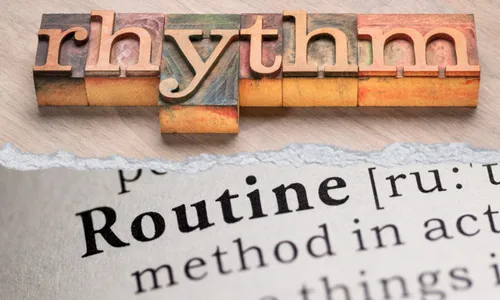
Rhythm vs. Routine: What is the Difference?
One of the members inside the Collective (my membership) asked an insightful and helpful question: What is the difference between a rhythm and a routine? And with kinder words, what in the world is an anchor?!
I say the word "rhythm" quite a bit. In fact, my course is called the "Rooted Rhythms Method". It's funny how you don't always think about why you say what you say until someone asks the pointed question.
Those questions are so good. It is always a good practice to think through why we think what we think, and be able to articulate it. It's also good to consider the gaps and holes, and to grow in our thinking and perspective.
So, all that to say, I want to take a stab at providing some clarity around what I mean by these words. And, as always, provide a couple of practical takeaways. Because you know I like practical.
Rhythm Vs. Routine
On the surface, it can seem like it's just a matter of semantics—and honestly, I've used both words interchangeably. However, in my opinion, these two words carry a bit of a different feel. I tend to use the word "rhythms" more often, because it more so reflects the cadence of the day. And to my ear, it sounds a bit less rigid.
I don't think that using the word "routine" is bad at all. It's a very common word. But I have found that it can sometimes come with some baggage. I could be totally wrong here (and perhaps I'm just projecting), but I think that some people can associate it with something that HAS to get done, no matter what. Because "it's my routine, dangit"- haha. Of course, there are certain things that HAVE to get done, but hopefully you can understand what I'm trying to say. Here, I am speaking more of preferences and desires, rather than musts.
Why Do I Like "Rhythms"...and What in the World is an Anchor?
In my mind, a "rhythm" flows with the cadence of the day. There are anchor points, which are the fixed points in a day (e.g., meals, sleep, and so on); and then there are the tasks that cluster around them, before or after. We move through those faithfully each day, generally speaking.
And because it's a rhythm, and not a rigid "have to" checklist, we are not totally thrown off when it doesn't go our way. Instead, we operate with the knowledge that man plans his way, but the Lord establishes our steps (Prov. 16:9). We get to trust in a wise and loving God when things don't happen according to plan because of His Divine Providence.
And, we are relieved. Because rhythms are cyclical. They always come back around. That is how God made the world work.
This Week's Takeaway
One reason I love anchor points and rhythms is because of how they help me with consistency. If I am trying to start a new habit to better steward our home, our family, my body, etc., I employ "habit stacking".
In other words, I latch the new habit onto an anchor point (AKA fixed point) in the day, such as a meal or the children's rest time. The beauty of anchor points is that they happen every day, no matter what, without me thinking about it. It's incredibly helpful to leverage these points in the day as a cue to remember the new habit. And the new habit becomes a part of the rhythm of the day.
So if you would like to try this out, think of one specific habit that you would like to build. And then get specific. At what anchor point in the day could you do the thing? In the morning when you wake? Before a meal? After a meal?
Pick what makes most sense, latch the new habit onto the anchor point, and let that be your cue.